
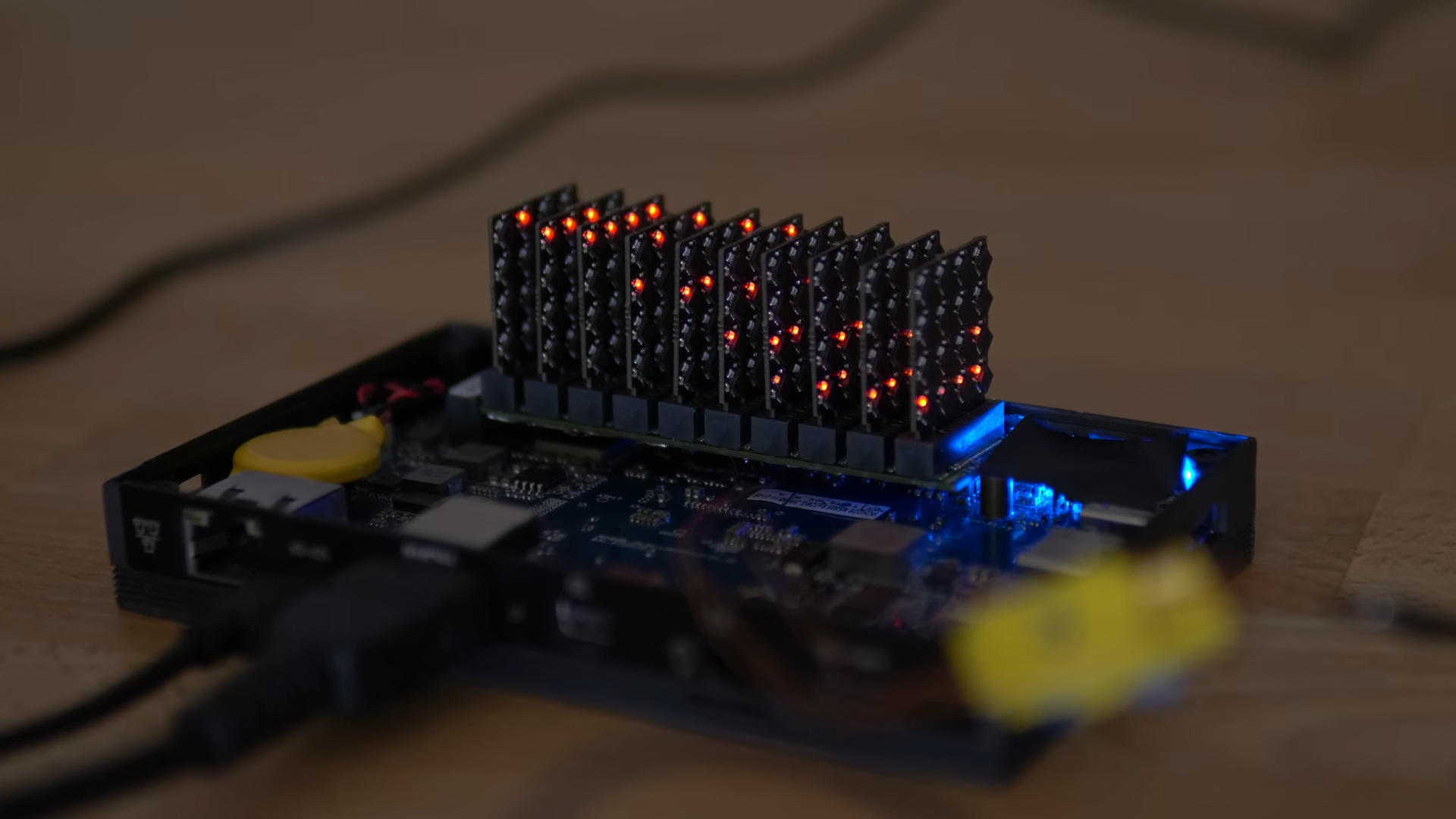
160-Core RISC-V Supercluster on an M.2 Board for Parallel Computing Tasks
In a new project, [bitluni] has created a 160-core RISC-V supercluster packed onto a single M.2 board. While each core is modest, operating at 48 MHz with the CH32V003 chip, the massive parallelism of the 160 cores promises intriguing computational potential. This setup is reminiscent of supercomputers from the 1980s, though far more compact. The system is connected over PCIe using a WCH CH382 serial interface, and it runs tasks like raymarching. While it’s not replacing modern GPUs, it offers a fascinating demo of parallel computation. Despite the impressive number of cores, the main bottleneck is the serial communication speed, limiting how fast the system can transfer data. This project highlights the challenges and opportunities of massively parallel computing with relatively low-power cores. With a power draw of just 4 watts, this system provides an efficient means for low-bandwidth, compute-heavy tasks, although it’s clear that further optimization could unleash more of its potential. Enthusiasts of RISC-V and parallel architectures will find this project an exciting demonstration of what’s possible with modular, inexpensive components.