
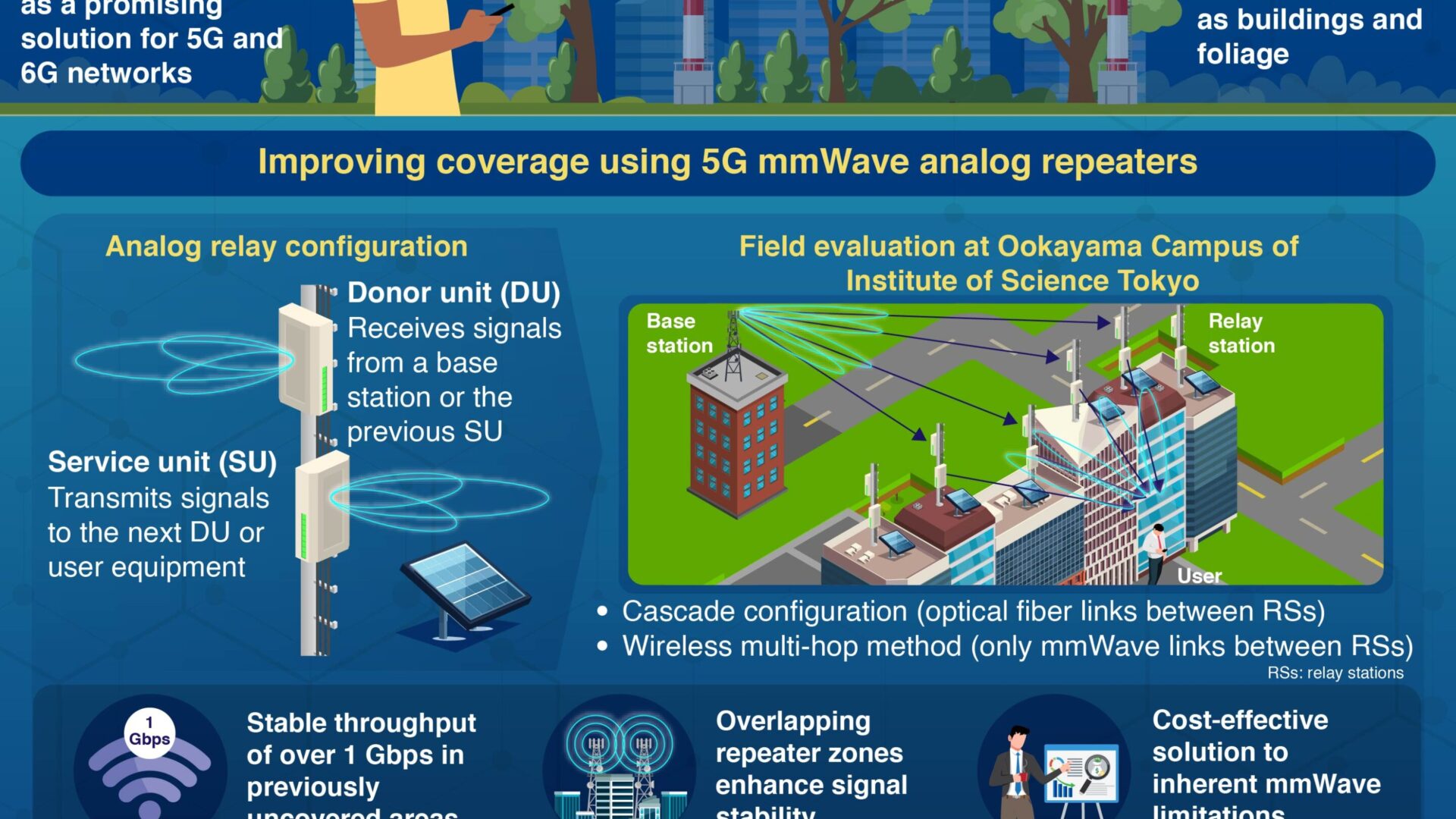
Analog repeaters enhance mmWave coverage, supporting 5G and 6G deployment
Researchers from the Institute of Science Tokyo have demonstrated the potential of analog repeaters to solve key challenges in millimeter-wave (mmWave) network deployment. These high-frequency signals, ideal for 5G and 6G, suffer from signal blockage due to environmental obstacles. The research team showed that by using low-cost repeaters, either connected via optical fiber or through wireless links, they could expand mmWave coverage, overcoming such blockages and boosting throughput to over 1 Gbps. In real-world tests on the Ookayama Campus, these repeaters provided stable communication even in non-line-of-sight (NLOS) environments, where traditional base stations struggle. This solution offers a cost-effective approach to extending coverage in urban and high-traffic areas, making it a promising development for the next generation of mobile networks. The study also showed that multiple repeaters working together created stronger and more reliable signals, even when obstacles like human bodies blocked the direct path. This advancement could be crucial for dense urban areas with high pedestrian movement, ensuring reliable connectivity in the future of 5G and 6G networks.