
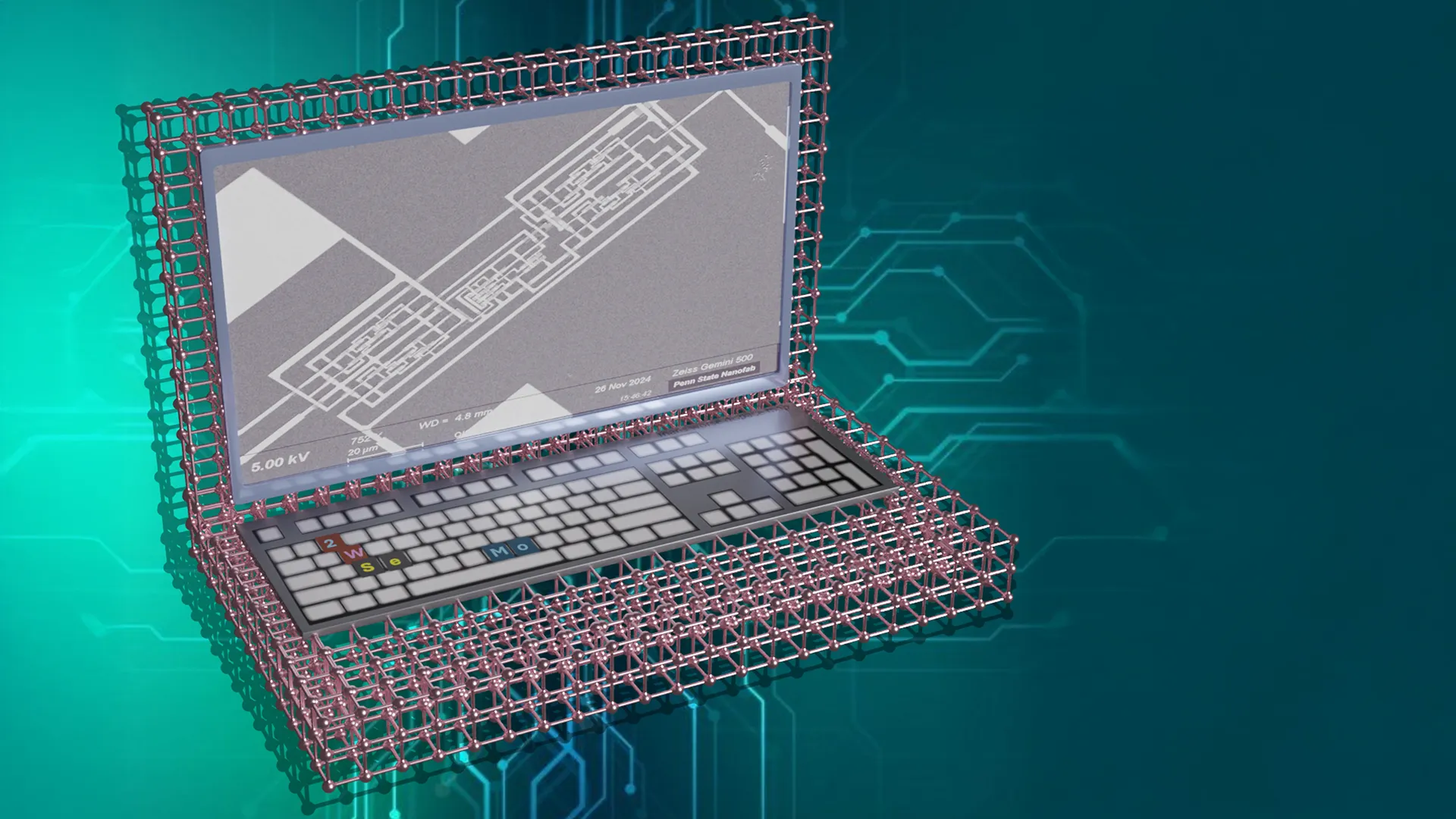
Penn State Develops First Fully 2D Material-Based CMOS Computer, Marking a Milestone in Post-Silicon Electronics
Researchers at Penn State have achieved a significant breakthrough in the field of electronics by developing the world’s first working computer built entirely from atom-thin, two-dimensional (2D) materials, rather than traditional silicon. Published in Nature, their work demonstrates a complementary metal-oxide semiconductor (CMOS) computer using molybdenum disulfide for n-type transistors and tungsten diselenide for p-type transistors. This approach addresses the limitations of silicon, which loses electronic performance as devices shrink, while 2D materials retain exceptional properties at atomic thickness. The team fabricated over 2,000 transistors on large-area sheets using metal-organic chemical vapor deposition and successfully tuned the devices to construct functional CMOS logic circuits. Their prototype operates at low voltages and consumes minimal power, performing simple logic operations at up to 25 kilohertz. While not yet matching the speed of conventional silicon-based computers, this proof of concept highlights the potential for slimmer, faster, and more energy-efficient electronics. The researchers emphasize that, although further development is needed, this achievement marks a major step forward in the transition beyond silicon, with 2D materials research advancing rapidly since its emergence around 2010.