
Researchers Develop 3D Holographic Data Storage Method Using Light and AI
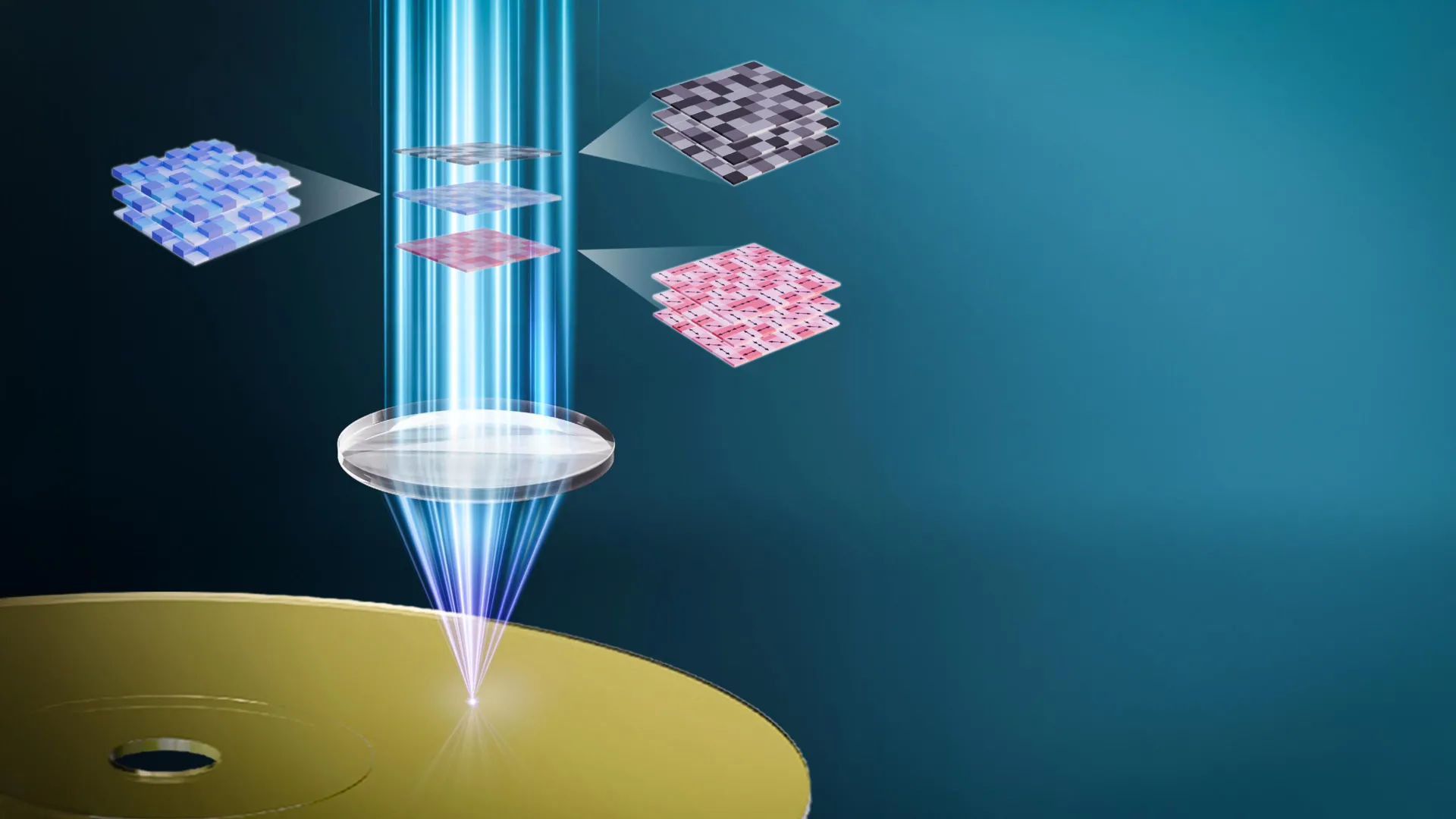
 A team of researchers from Fujian Normal University has developed a new form of holographic data storage that could significantly boost how much information can be stored and retrieved. Unlike conventional systems that write data onto flat surfaces such as hard drives or optical discs, this technology embeds data throughout a material using laser light in three dimensions. The method combines three properties of light — amplitude, phase, and polarization — enabling multidimensional encoding and substantially increasing storage density. The study, published in *Optica*, uses a deep learning model, specifically a convolutional neural network, to decode information from the resulting complex light patterns. This neural network reconstructs all three data dimensions—amplitude, phase, and polarization—from two diffraction images captured under different polarization conditions. The process eliminates the need for complicated reconstruction steps, making optical data retrieval faster and more efficient. The researchers also implemented a tensor-based polarization holography approach to maintain light’s polarization state during reconstruction, ensuring stable performance. Their prototype demonstrated successful multidimensional encoding and decoding inside a polarization-sensitive material. Although the system is still in the research stage, it could eventually lead to smaller data centers, faster data transmission, improved optical encryption, and more robust large-scale archival storage solutions. Future work will focus on expanding data capacity by increasing encoding gray levels and improving the durability and reliability of the optical storage materials.